Original title: Explorando las brechas de género en Colombia (in Spanish)
Authors: María Teresa Ramírez-Giraldo (coordinator), Karina Acosta-Ordoñez, Olga Lucía Acosta-Navarro, Lucía Arango-Lozano, Fernando Arias-Rodríguez, Oscar Ávila-Montealegre, Oscar Becerra-Camargo, Leonardo Bonilla-Mejía, Grey Ceballos-García, Luz Adriana Flórez, Juan Miguel Gallego-Acevedo, Luis Armando Galvis-Aponte, Luis M. García, Andrés García-Suaza, Anderson Grajales-Olarte, Daniela Gualtero-Briceño, Didier Hermida-Giraldo, Ana María Iregui-Bohórquez, Juliana Jaramillo-Echeverri, Karen Laguna-Ballesteros, Francisco Lasso-Valderrama, Daniel Márquez, Carlos Medina-Durango, Ligia Alba Melo-Becerra, María Fernanda Meneses-González, Juan José Ospina-Tejeiro, Andrea Otero-Cortés, Daniel Parra-Amado, Juana Piñeros-Ruiz, Christian Posso-Suárez, Natalia Ramírez-Bustamante, Mario Ramos-Veloza, Jorge Leonardo Rodríguez-Arenas, Alejandro Sarasti, Bibiana Taboada-Arango, Ana María Tribin-Uribe and Juanita Villaveces-Niño
Published in: Ensayos sobre Política Económica (ESPE), No. 111, Banco de la República, March 2026
Overview. This essay from Banco de la República, Colombia’s central bank, documents gender gaps in Colombia across four areas: demography, education and poverty; the labor market; the macroeconomic effects of closing gender gaps; and policy recommendations. It covers time use and care work, the labor market effects of motherhood, female labor force participation, urban and regional wage gaps, and gender gaps in old-age economic protection.
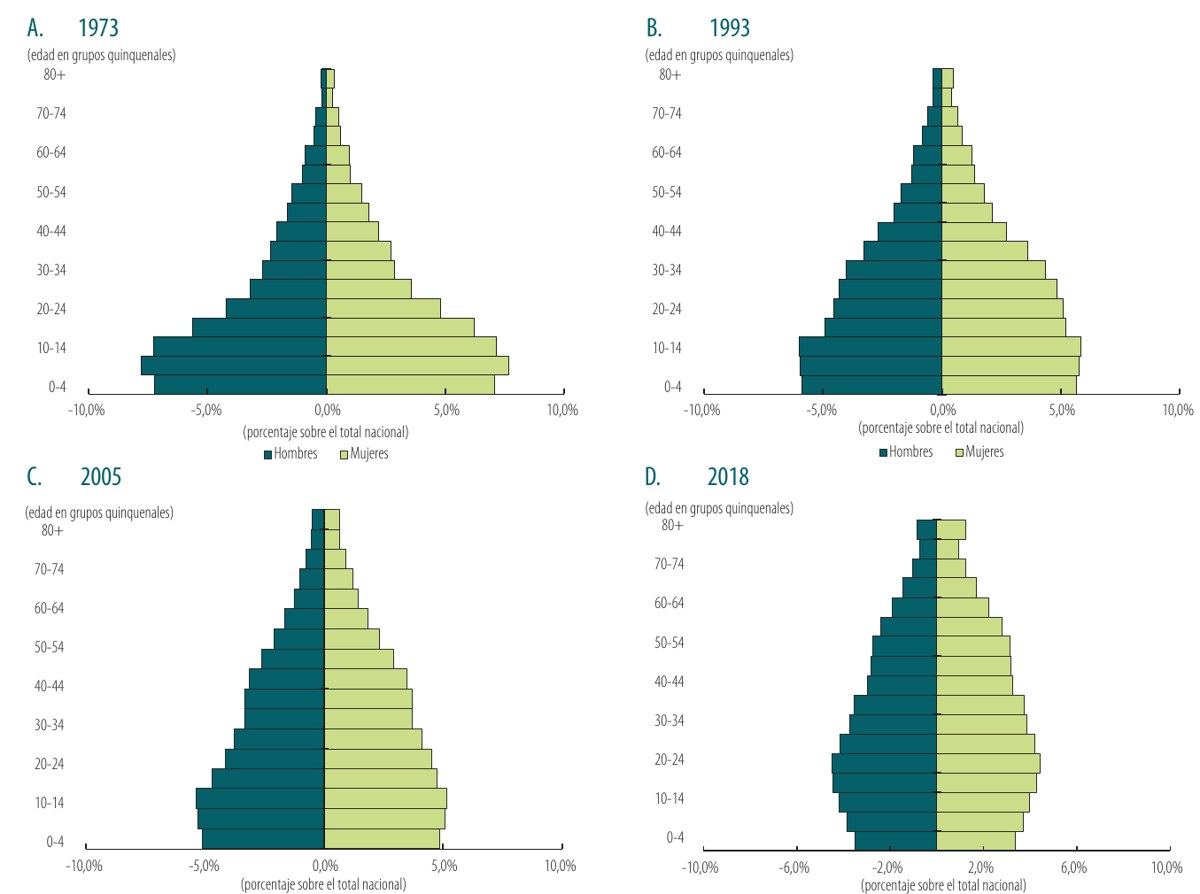
My contribution: Section 1.1, Gender demographic trends, 1973–2023. Using the population censuses of 1973, 1993, 2005 and 2018 and vital statistics on deaths (1979–2023) and births (1998–2023), the section documents how Colombia’s demographic transition has unfolded for men and women. The working-age population (15–65) has grown steadily since 1973, opening a demographic dividend that population ageing will gradually close. Monthly births have been declining, with a seasonal peak between August and November and a male-to-female birth ratio between 1.045 and 1.075, in line with the biological norm and with no sign of sex preferences at birth. Higher neonatal and infant mortality among boys offsets their slight majority at birth, and both rates have fallen steadily. Men outnumber women at young ages, but their share falls with age because of higher male mortality. The main causes of death are similar for both sexes, but external causes account for a much larger share of male deaths, while cancer weighs more among women.
JEL codes: J16, J21, J22, J31, O40
Keywords: gender economics, labor market discrimination, wage differentials, Colombia
Population change by census, 1973–2018
| 1973 | 1993 | 2005 | 2018 | |
|---|---|---|---|---|
| Total population | 19,758,921 | 32,132,721 | 41,174,853 | 44,164,417 |
| Households | 3,291,771 | 6,979,775 | 10,570,899 | 14,252,829 |
| Population change | 62.6% | 28.1% | 7.2% | |
| Annual growth | 2.5% | 2.1% | 0.6% | |
| Men | 48.9% | 49.0% | 48.8% | 48.8% |
| Women | 51.1% | 51.0% | 51.2% | 51.2% |
| Under 15 | 44.1% | 34.4% | 30.6% | 22.7% |
| Over 65 | 3.1% | 4.5% | 6.3% | 9.1% |
Source: DANE population censuses. The largest change between 1973 and 2018 is population ageing.