Original title: Nueva evidencia sobre la informalidad laboral y empresarial en Colombia (in Spanish)
Authors: Andrea Otero-Cortés (coordinator), Karina Acosta, Luis Eduardo Arango, Danilo Aristizábal, Óscar Ávila, Óscar Becerra, Cristina Fernández, Luz Adriana Flórez, Luis Armando Galvis, Ánderson Grajales, Catalina Granda, Franz Hamann, Juliana Jaramillo, Carlos Medina, Jesús Morales, Alejandra Morales, Leonardo Morales, Juan José Ospina, Christian Posso, José David Pulido, Mario Ramos and Alejandro Sarasti
Published in: Ensayos sobre Política Económica (ESPE), No. 108, Banco de la República, February 2025
Overview. This essay from Banco de la República, Colombia’s central bank, brings together new evidence on labor and business informality in Colombia. It characterizes informality across regions and groups, reviews the public policies and interventions designed to reduce it, and studies its macroeconomic effects, closing with the main lessons for policy.
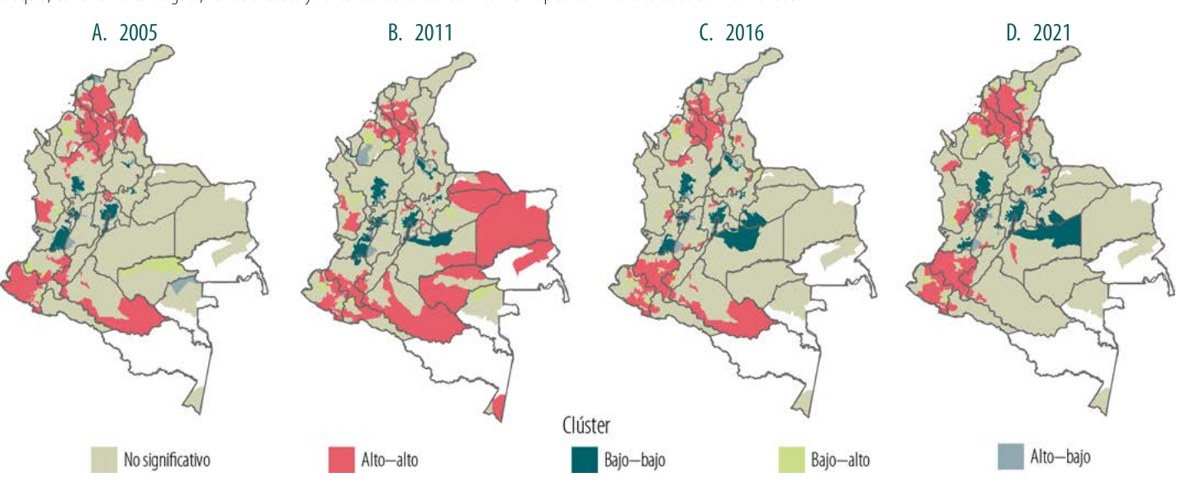
My contribution: Section 1.2, Labor informality in small municipalities. Most research on informality in Colombia covers the national level or the main cities, because the household survey (GEIH) is not representative for most municipalities and many are never sampled. Building on Acosta-Ordóñez et al. (2024), the section uses small area estimation, a transformed Fay-Herriot model fed with administrative records (social security contributions, public employment service, national accounts and census projections), to estimate labor informality for 1,093 municipalities between 2005 and 2021. National informality was 61% in 2021, with municipal rates ranging from 25% to 97%. The simple municipal average fell from 89.7% in 2005 to 77.3% in 2021, with most of the decline before 2016, and the most informal municipalities lost part of their gains after the pandemic. A spatial cluster analysis (LISA) shows persistent high-informality clusters in the Caribbean and the Pacific, especially in Bolívar and Nariño, and low-informality clusters in Antioquia, Cundinamarca-Bogotá, Valle del Cauca and Santander.
JEL codes: J21, J23, J46, J48, O17
Keywords: informality, public policy, labor market