Author: Alejandro Sarasti-Sierra
M.A. thesis, Universidad de los Andes · Advisor: Christian Posso, Principal Economist, Banco de la República
Abstract. This paper studies how changes in the firm’s observables affect their credit and productivity. We exploit the Colombian government’s decision to move from COLGAAP to IFRS, which was announced in 2012 and reached two groups of firms at different times: Group 1 adopted full IFRS in 2015 and Group 2 followed in 2016. We combine financial statements, bank credit records, employer-employee data and customs records for a panel of medium and large firms between 2009 and 2019, and estimate difference-in-differences models that take the announcement as treatment. Outcomes from sources independent of the accounting standard let us separate mechanical changes in reported figures from real effects.
Keywords: IFRS adoption, credit allocation, firm productivity
JEL codes: M41, D24, G30
Identification
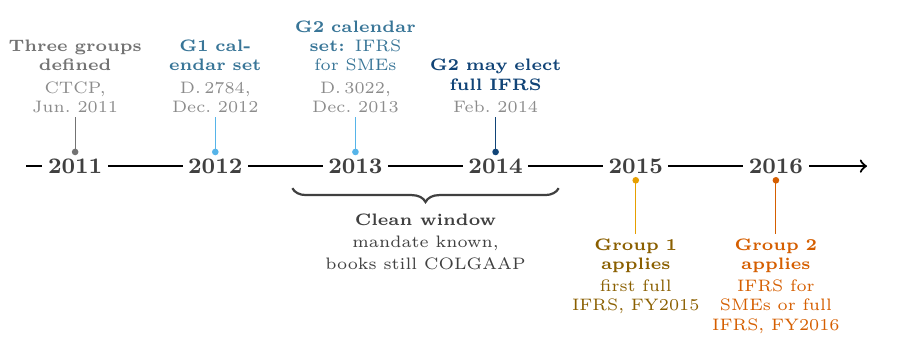
The switch from Colombian GAAP to IFRS reached Group 1 and Group 2 firms on different calendars. Between the announcement and the first IFRS reports there is a clean window (2013–2014) in which firms already knew the mandate but still kept their books under COLGAAP, so outside agents could not yet see the new information.
Data
A firm-level panel of 38,468 medium and large Colombian firms (224,955 firm-year observations, 2009–2019) that links balance sheets reported to the Superintendencia de Sociedades, bank credit records, employer-employee data (used to estimate firm wage premia with a time-varying AKM model) and customs records on imports and exports.